Jaelyn Grant
Reporter
Merry MacLellan
Editor
With the days growing shorter and darkness arriving earlier, students at Mississippi University for Women often face a dark walk back to their dorms or the cafeteria. There are some places on campus where lights bulbs are out, and the dark corners can make students nervous about walking alone.
But the danger isn’t always hiding in the darkness.
One student at The W faced this in the spring semester after what she termed a stalking incident with a male student. Aalaya, “Laya,” Campbell is a biology major and a peer mentor through the Student Success Center here at The W. During the spring semester, a male student who was in a few classes with her began sending her unprompted messages, forcing uncomfortable conversations and showing up during her library hours as a peer mentor.
“He would make me feel like I was obligated to help him,” Campbell said. “He literally told me in one of my emails that I was obligated to help him because of a shared past experience because we were both in the Air Force. So, he said because I was an airman, a veteran, I’m obligated to help him. He told me he loved me through email.”
That’s when Campbell decided to file a report about what was happening. She shared it first with her professor, then the department chair, and then the Dean of Students. However, when she tried to file a Title IX report, she said her situation and the other student’s behavior were deemed ineligible for a Title IX complaint.
As a federally instituted program, Title IX is designed to prohibit any sexual discrimination or harassment at a school that receives federal funding. At The W, there is a Title IX coordinator and 10 Title IX deputies on campus who can investigate reports when they are filed. On the Title IX’s university page, it states, “Any student, faculty or staff member who has knowledge of or concerns about sex or gender-based discrimination and harassment, including sexual harassment, sexual assault, dating violence, domestic violence or gender-based stalking, is encouraged to contact the Title IX Coordinator or Title IX Deputies.”
At The W, Title IX is advertised across campus with information about how to file a report. There are magnets in bathrooms, stickers in the windows of offices and flyers on bulletins boards — all to educate students. Dr. Matthew Miles, the dean of Student Affairs, emphasized the importance of Title IX’s accessibility. However, as Campbell found, reports don’t always go through.
“We want to protect the rights of all parties involved, whether it’s staff, faculty or students in that way,” Miles said. “And then from there, if there is information to be found, then we will issue supportive measures or sanctions based on what the student handbook and Title IX is allowed to do.”
The standard for a ruling is taken case by case. Each outcome and sanction will look different according to the mandates of Title IX, even possibly including the dismissal of students. Miles stressed that during the process, it’s important that comments from both parties are taken into account.
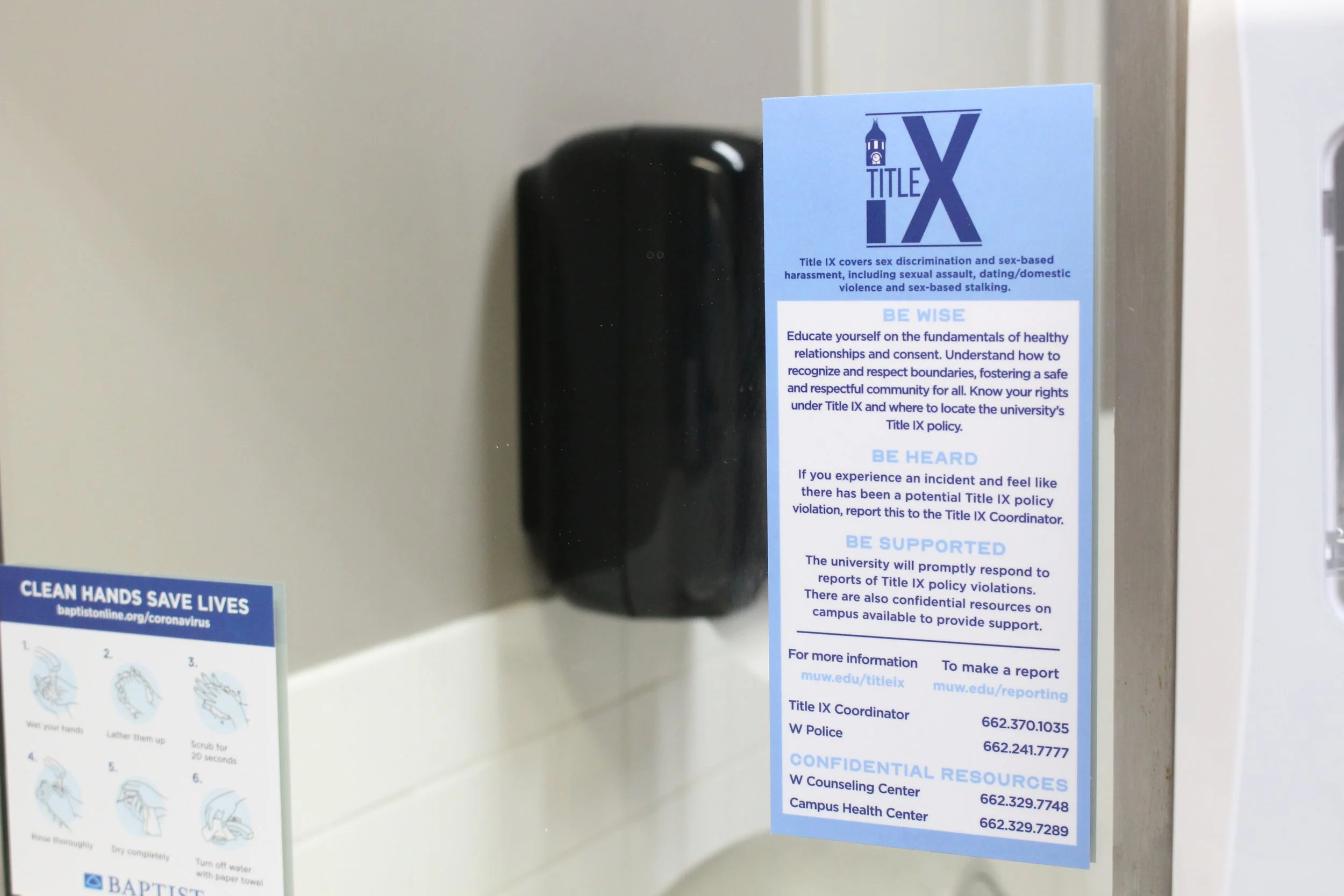
One of the Title XI flyers posted on campus
Photo by Merry MacLellan
In Campbell’s case, no action was taken, even though she said this student was known to have caused prior issues for several other women on campus.
“He has had previous documented instances of stalking other women on campus, but he had never taken it to the level he had taken it with me, and that was their thing,” Campell said.
Campbell said she felt as if those in charge put blame on her for not doing enough to make it clear to him that she was uninterested. She said that she had attempted to establish strict boundaries with the student, and her husband actually became involved in some of the exchanges.
“Like it just, I was flabbergasted,” Campbell said. “I felt so alone. I felt unprotected.”
She began to fear for her safety on campus, with worry that the stalking could escalate into something physically dangerous. Even though Title IX sometimes can provide accommodations so that the victim does not have to be around the reported person, she was not provided with that option. Instead, he was moved to the back of the classroom.
While her stalker did end up unenrolling from the university, Campbell said the distress and damage could not be undone.
“He took so much from me,” Campbell said. “He took my piece of mind, and that is just harrowing to think about. Even still, I walk around campus, I drive around campus, and still I look around for him. I go and sit down in my classes, we’re in October, it’s past fall break, no one new’s coming into class, but I am still vigilant. I am still aware of my surroundings in a way that I did not have to be before, and that’s not fair.”
With stalking taking many different forms including online or in-person, Campbell acknowledged that it can be a gray area and said she wished that the university would take a tougher stance against it.
“So, university leadership just needs to realize like this is how it starts off,” Campbell said. “Those other women is truly how it started off, and I knew that if I did not make enough noise, he would stay, and he would truly assault someone physically. And I told anyone who listened to me, like this is his next step.”
Campbell’s outspokenness about the incident is how The Spectator learned about what happened. At the time it was ongoing, she said she did not want to involve any outside parties in the hopes that the case would be dealt with through Title IX. It was when the other student left the university that she agreed to speak with the student newspaper.
Campbell said that she tries to be more aware of her surroundings and vigilant on campus, and she is probably not the only student who feels that way. Having a formal process for reporting problems doesn’t stop students from facing nervous moments while walking on campus, especially after dark.
The W once offered the Night Owls program in which students could call the campus police department and receive an escort at night. However, this program was disbanded at some point in 2025 — the Spectator was unable to confirm a date — but most people on campus were not aware that the program had ended.
At a town hall event hosted by Student Government Association in Spring 2026, students still believed that the program was active only to learn that was not the case. This semester, now a year since the program ended, there were still faculty members who believed the resource existed. This, along with outdated safety information on the police department’s website, were causes of concern to people on campus.
Randy Vibrock, the campus police chief, said that while the Night Owl program is no longer active, students are still able to call the police department and receive an escort.
“Now, the process is still the same as the Night Owl service,” Vibrock said. “The student would call our department, request that transport and then the student would provide their student ID. And then, as long as the golf cart is available, they would provide a shuttle on the golf cart.
“So, if the security officer is not available, then they can still call our department and then one of our patrol officers will provide a walking escort. So, the service is available at any time.”
Vibrock acknowledged that the lack of advertisement about the new way to get a campus escort has been an oversight on the department’s part, and he apologized. He expressed interest in having that changed to reflect current information so that students and faculty would be aware of the current campus safety resources.
For any students who might have experienced similar harassment to Campbell, felt unsafe on campus or dismissed by faculty, it is important to know that even when departments fail, it is your right as a student to speak up and out about any injustice you may have faced.
“It just takes one person to say: I’m going to stand here against this storm to protect all the others who I know have come before me and give them the courage to come forward and speak,” Campbell said. “Because I promise you, like I’m not the only one, and he was not the only one.”